
Polymarket Fees: Trading Costs, Spreads, Liquidity, and Network Charges
Understand Polymarket fees, including taker fees on some markets, fee-free categories, deposit and withdrawal notes, spreads, and liquidity costs.
Polymarket charges small taker fees on certain markets, while some categories are fee-free. Polymarket says it does not charge its own deposit or withdrawal fees, but exchanges, card providers, bridges, and networks may charge their own costs. Always check the live market and current fee information before trading.
- Separate Polymarket taker fees from network, bridge, exchange, and card-provider costs.
- Look at spread and liquidity before you treat a market as cheap to trade.
- Check whether the specific market has fees enabled before sizing a trade.
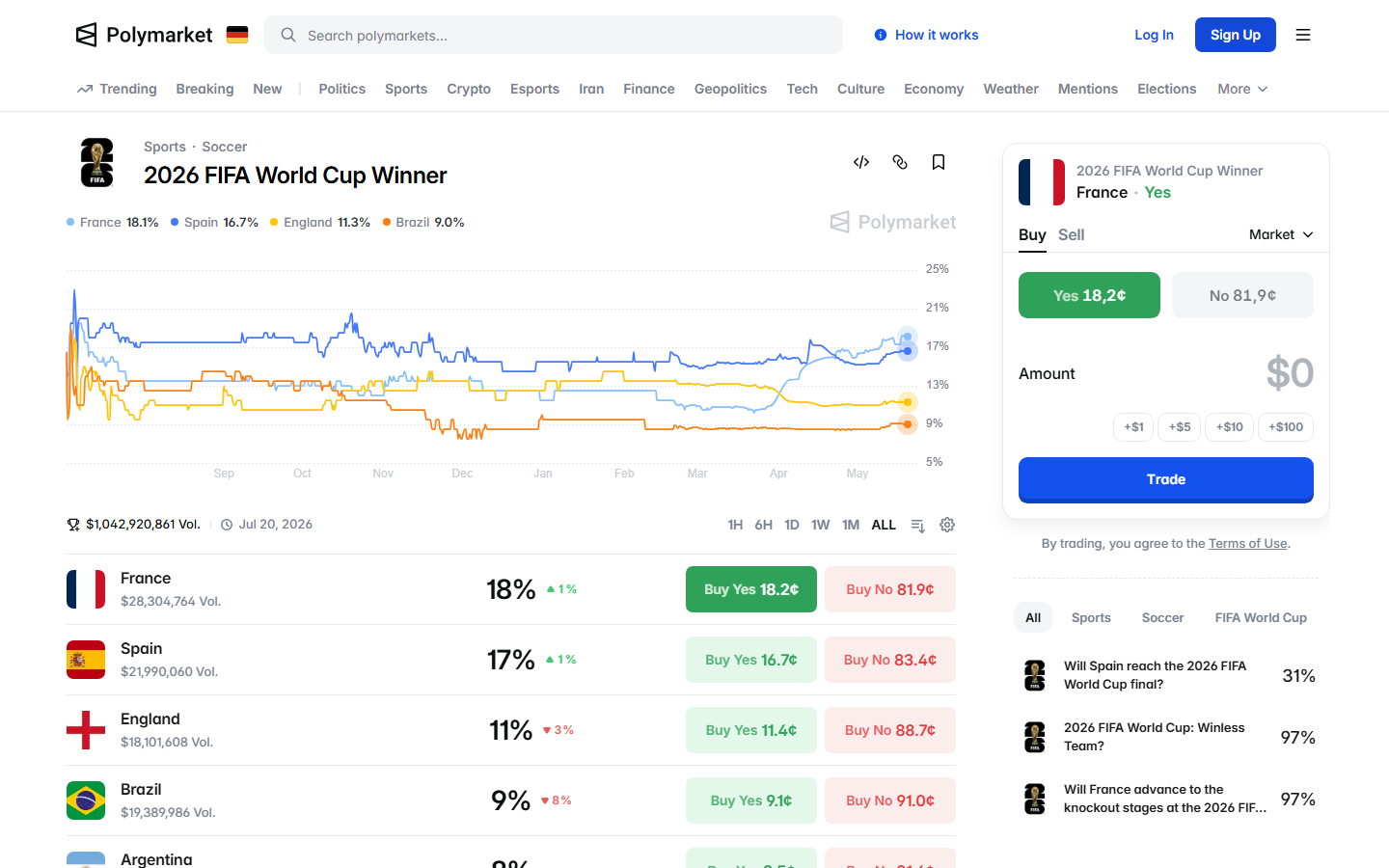
The different costs users call fees
Fee searches can mix Polymarket taker fees, network costs, bridge costs, exchange withdrawal costs, card-provider charges, and the price impact of trading in a thin market. Check Polymarket's current fee information before funding, then estimate any outside transfer costs separately.
- Makers and takers can face different economics.
- Some market categories are fee-free while others can have taker fees.
- Intermediaries can charge even when Polymarket does not charge its own deposit fee.
Why spread matters
A wide spread can make a trade expensive even when the explicit fee is small or zero. Liquidity determines how close your execution may be to the price you expected. Before you trade, compare bid and ask depth instead of reading only the headline probability.
How to research costs before trading
Open the market, review the trade ticket, fee information, price, depth, and recent activity. On fee-enabled markets, the interface can show the exact fee before you submit the trade. Combine fee checks with market research so your expected edge is not consumed by spread, slippage, or transfer costs.
A Polymarket cost search should separate explicit trading fees, bid-ask spread, slippage, exchange withdrawal fees, card-provider fees, bridge costs, and network costs. These costs hit different steps and should not be collapsed into one number.
The docs describe the trading-fee formula as fee = C x feeRate x p x (1 - p), where C is shares traded and p is share price. Makers pay zero in the published table; takers can pay a category-specific rate when fees are enabled. A market with zero explicit fee can still be expensive if the spread is wide.
| Category | Taker fee rate | Maker fee rate | Maker rebate |
|---|---|---|---|
| Crypto | 0.07 | 0 | 20% |
| Sports | 0.03 | 0 | 25% |
| Finance | 0.04 | 0 | 25% |
| Politics | 0.04 | 0 | 25% |
| Economics | 0.05 | 0 | 25% |
| Culture | 0.05 | 0 | 25% |
| Weather | 0.05 | 0 | 25% |
| Other / General | 0.05 | 0 | 25% |
| Mentions | 0.04 | 0 | 25% |
| Tech | 0.04 | 0 | 25% |
| Geopolitics | 0 | 0 | - |
Polymarket says it does not charge its own deposit or withdrawal fees in the relevant docs, but outside providers can charge. Coinbase, Binance, wallets, card processors, bridges, and networks can all add costs before or after Polymarket sees the funds. Track the full route: money into the funding source, transfer into Polymarket, trade execution, sale or resolution, and withdrawal out.
Liquidity decides whether the price you see is the price you can trade. If you buy more shares than the top ask can fill, your order may move into worse prices. If you sell into a thin bid, your exit can be worse than the displayed probability.
This is why fee analysis belongs next to order-book analysis. The explicit fee may be smaller than the spread or slippage.
Suppose you buy 100 shares at $0.50 in a crypto market with fees enabled. The docs' formula gives 100 x 0.07 x 0.50 x 0.50 = 1.75 USDC before considering spread or slippage. The same formula is lower near the extremes because p x (1 - p) gets smaller.
Now add the order book. If the best ask is $0.57 and the best bid is $0.53, buying and immediately selling can lose value before the market outcome changes. The trade needs enough expected edge to beat explicit fees, spread, and exit cost.
Check Polymarket Docs for fee formulas and the live trade ticket for market-specific fees. Then check your exchange, wallet, or payment provider for transfer costs. If the docs and the trade ticket differ, use the current trade ticket for the order in front of you and save the details before confirming.
A full cost stack can include exchange withdrawal cost, network cost, explicit taker fee, spread, slippage, and withdrawal cost after the trade. A trader who only checks one layer can overestimate the edge.
For small trades, fixed outside costs can dominate. For large trades, spread and depth can dominate. Fee analysis changes with position size.
Polymarket's fee docs distinguish makers and takers. A market order or crossing the spread can have different economics from resting a limit order. The interface and docs should tell you which fee logic applies.
Do not copy another trader's cost assumption unless you know how that trader entered. A wallet that posted liquidity may not face the same execution as a beginner who crosses the spread.
Before entering, write down the best bid, best ask, displayed price, expected fill, explicit fee, position size, and likely exit route. Then ask whether the expected edge still exists after those costs. If you cannot exit without moving the market, the trade is more expensive than the headline price suggests.
A market can be too thin when your intended order would consume several price levels, when recent activity is stale, or when the spread is wide enough to erase the expected gain. Thin markets are not always bad, but they demand smaller sizing and a clearer reason to hold through resolution instead of relying on an easy exit.
A beginner buying a small amount at the ask, a high-volume trader placing limit orders, and a whale moving several price levels do not experience the same cost. The headline fee may be identical while execution cost differs.
This is why wallet research matters. If a top trader appears profitable, check whether the wallet earns from timing, market selection, liquidity provision, or simply taking large directional risk.
Funding method can change the trade math before the trade starts. An exchange withdrawal fee, card provider fee, or network cost can be large relative to a small first position.
If you plan a small test trade, calculate outside costs first. A fee that looks minor for a large account can distort results for a beginner.
Save exchange withdrawal records, provider receipts, transaction hashes, trade confirmations, and withdrawal records. These details help you calculate true performance later. Without records, PnL can look better than reality because transfer costs and slippage disappear from memory.
Before entering a Yes or No position, estimate the price needed to make the trade worthwhile after costs. If you buy Yes at $0.57 with a wide spread, your break-even is not the same as the displayed midpoint. This thinking protects beginners from trades that look attractive as probability guesses but fail once execution and exit costs are included.
Two markets can show similar probability but very different tradable cost. Prefer the market with clearer rules, tighter spread, more active buyers and sellers, and a fee profile you can understand.
When costs are unclear, reduce size or wait for better liquidity. The cheapest trade is sometimes the one you do not force, especially when the exit path is thin or stale today for your size and timing plan assumption.
Check these official Polymarket sources before you act on referral terms, deposit methods, fees, availability, verification, or resolution details.
Last verified: May 20, 2026
Inspect market depth, spread, and recent activity before entering.
Review current platform details directly on Polymarket before you trade.
Tools and related reading referenced by this guide.
Continue with nearby Polymarket research topics.
Learn Polymarket's current deposit steps: click Deposit, choose method, token, network, copy the address, send the minimum, and wait for confirmation.
Learn how betting on Polymarket works through Yes/No shares, prices, probability, liquidity, order books, settlement, and trader research.
Learn how to use Polymarket from signup to research, deposits, market selection, Yes/No shares, position tracking, and risk checks.