Updated May 20, 20267 min read

Polymarket Yes/No Shares Explained: Prices, Payouts, and Risk

Understand Polymarket Yes and No shares, market prices, implied probability, payout math, early selling, liquidity, and beginner risks.

Quick answer

Polymarket Yes and No shares are positions on opposite outcomes. A share trades between $0.00 and $1.00, and the side that resolves correctly can pay $1.00 per share. The displayed price can look like probability, but your real trade depends on the bid, ask, spread, liquidity, fees, and final resolution.

Key takeaways
  • Yes shares profit when the event resolves Yes; No shares profit when it resolves No.
  • A $0.70 price can be read as a 70 percent market-implied signal, not a promise.
  • Your entry and exit price can differ from the displayed midpoint.
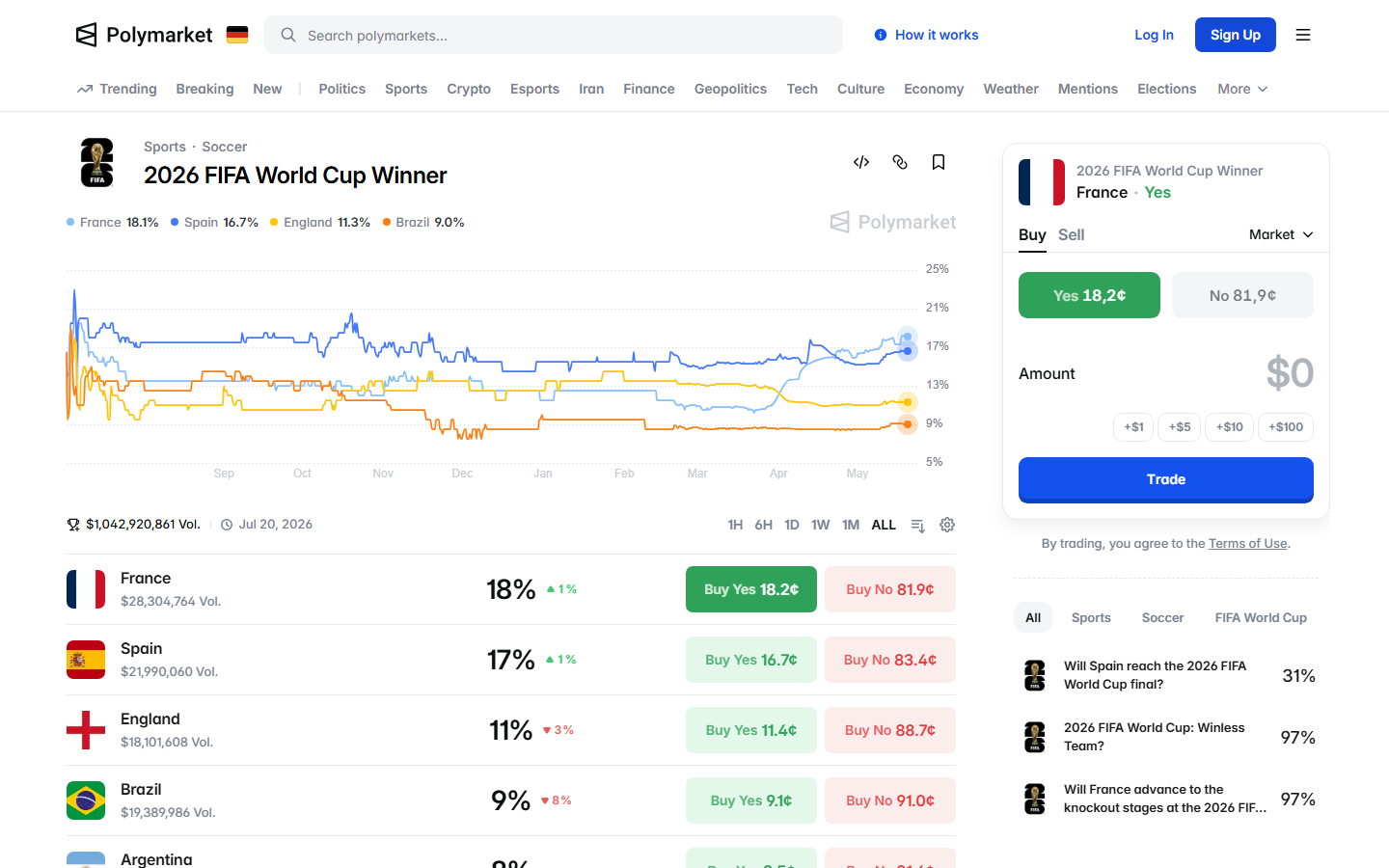
Polymarket event page with outcome prices, chart, and buy Yes or No controls
A Polymarket event page shows outcome prices, recent movement, volume, and the trade ticket.

Yes and No share basics

A Yes share backs the event happening. A No share backs the event not happening. Each side trades while the market remains open, and the correct side can redeem at $1.00 after resolution.

If you buy Yes at $0.40 and it resolves Yes, the gross payout is $1.00 per share. If it resolves No, that Yes share expires worthless.

Why prices look like probabilities

A price near $0.62 can be read as a 62 percent market-implied probability because traders are choosing what they will pay for the outcome. Polymarket says displayed prices usually use the midpoint of the bid-ask spread, unless the spread is wider than 10 cents.

Your actual entry price can differ because you buy from available liquidity. Always check the trade ticket before confirming.

Payout and risk math

The simple math is entry price versus $1.00 if you win, or $0.00 if you lose. Buying 50 shares at $0.30 costs about $15 before any extra costs. If those shares resolve correctly, the gross payout is $50.

That payoff can look attractive, but low-priced shares often reflect outcomes the market thinks are unlikely. Do not size a trade only because the upside looks large.

Liquidity and early exits

You can sell shares before resolution if the market is open and buyers exist. This makes Yes/No shares more flexible than a fixed wager, but only if liquidity supports the exit. Use event analytics and activity views to check whether a market has enough recent trading before you enter a position you may need to exit early.

Share mechanics

Yes and No shares represent opposite sides of the same market question. Each share trades between $0.00 and $1.00 while the market is open.

The correct side can pay $1.00 after resolution. The wrong side expires worthless.

Displayed price vs fill price

The displayed probability helps you read the market, but your fill comes from available orders. If the best ask is above the displayed midpoint, you pay more to enter. Always check the trade ticket and order book before treating a displayed percentage as your execution price.

Price display vs execution
SignalHow to read it
$0.2525% implied chance
$0.5050% implied chance
$0.7575% implied chance
Best bid / best askThe actual prices buyers and sellers currently show
Displayed priceUsually bid-ask midpoint; last traded price may show when spread is wide
Risk per dollar

Buying a low-priced share risks the amount paid and can return more if it resolves correctly. Buying a high-priced share risks more per share but reflects a market that traders see as more likely.

The right question is not whether the price is low or high. The right question is whether the price is wrong.

Yes/No math example

Buying 200 No shares at $0.25 costs about $50 before extra costs. If No resolves correctly, the gross final value is $200. If No loses, those shares go to $0.

That math explains the payoff, not the quality of the trade. You still need rules, liquidity, and a thesis.

Two-sided market structure

A Yes share and a No share represent opposite claims on the same event. Polymarket's CTF docs describe binary markets as two tokens backed by pUSD collateral: Yes can redeem if the event occurs, and No can redeem if it does not.

This structure makes Polymarket feel different from a simple prediction poll. Price moves because traders exchange risk with each other, but the final redemption model still comes back to the resolved outcome.

Yes/No share payout model
ShareRedeems forWhen it wins
Yes$1.00 pUSDEvent occurs
No$1.00 pUSDEvent does not occur
Price and payout gap

The gap between the price paid and the $1.00 winning payout defines the upside. The price paid defines the downside if that side loses. A $0.20 share can return five times gross value if correct, but that same share can still lose the full amount paid.

Spread and depth example

If Yes displays near $0.50 but the best ask is $0.54 and only a small amount is available, a larger buy may fill at a worse average price. That difference affects expected value. A thesis that works at $0.50 may fail at $0.58 after slippage.

Common No-side misread

Buying No is not the same as shorting Yes with unlimited risk. You buy a No share for a set price, and that price is the amount at risk for that share.

The No side still needs its own thesis. A bad Yes price does not automatically make No attractive if liquidity or rules are poor.

Before-buy share checklist

Check the side, share count, average fill, maximum loss, resolution rule, and exit liquidity. Then decide whether the price is wrong enough to justify the trade.

This checklist keeps mechanics separate from conviction. You can understand Yes/No shares perfectly and still pass on a weak market.

Partial exit example

If you bought 100 Yes shares at $0.30 and the market rises to $0.60, selling 50 shares can recover capital while leaving 50 shares exposed to the final result. That choice changes risk without requiring a full opinion reversal. Partial exits are one reason Yes/No shares need position management, not just prediction.

Official sources to verify

Check these official Polymarket sources before you act on referral terms, deposit methods, fees, availability, verification, or resolution details.

Last verified: May 20, 2026

Review price movement

Check how the market price moved before buying Yes or No.

Review price movement
Check Polymarket terms

Review current platform details directly on Polymarket before you trade.

Check Polymarket terms
Useful links

Tools and related reading referenced by this guide.

Related guides

Continue with nearby Polymarket research topics.