Probabilidades de guerra nuclear en Polymarket: cómo leer los mercados de Nuclear Weapons y Nuke
Aprende a leer las probabilidades de guerra nuclear en Polymarket: redacción exacta, tipo de evento, fecha de cierre, liquidez, spread, volumen y reglas.
Las probabilidades de guerra nuclear de Polymarket son señales de probabilidad implícita, no pronósticos confirmados. Empieza por la pregunta exacta del mercado y después revisa el tipo de evento, el actor, la fecha de cierre, la liquidez, el volumen, el spread y las reglas de resolución antes de tomar como significativo cualquier precio relacionado con lo nuclear.
- Las páginas de Nuclear Weapons, Nuke e Iran nuclear pueden contener distintos tipos de mercados.
- La etiqueta de una categoría no es la pregunta del mercado; entra y lee las reglas.
- Poca liquidez o un spread amplio pueden debilitar una probabilidad de titular.
- La redacción de la resolución decide si una noticia afecta al resultado del mercado.
¿Qué significan realmente las probabilidades de guerra nuclear en Polymarket?
Las probabilidades de guerra nuclear en Polymarket son una señal de probabilidad implícita, no un pronóstico confirmado. Empieza por la pregunta exacta del mercado, no por la etiqueta de la categoría. Una página de armas nucleares, un mercado de Polymarket sobre un arma nuclear iraní, un mercado sobre una prueba nuclear y un mercado sobre la salida del NPT pueden describir eventos distintos. Antes de tomar cualquier precio como significativo, revisa:
Usa el precio como señal, pero evita tratar mercados con poca liquidez, sin actividad reciente o ambiguos como evidencia sólida.
- ¿Qué evento hace que SÍ se resuelva?
- ¿Cuál es la fecha de cierre?
- ¿Cuánta liquidez y volumen hay?
- ¿El spread entre compra y venta es estrecho o amplio?
- ¿Qué reglas y fuentes deciden la resolución?
¿Por qué es fácil malinterpretar las probabilidades de guerra nuclear en Polymarket?
«Probabilidades de guerra nuclear» es una frase de búsqueda. No siempre es la pregunta literal que plantea Polymarket.
En Polymarket, los mercados relacionados con lo nuclear pueden incluir preguntas sobre armas nucleares, pruebas nucleares, el programa nuclear de Irán, el enriquecimiento de uranio, la salida de un tratado, la diplomacia, la acción militar, las licencias de reactores o incluso terminología «nuke» vagamente relacionada. La página de predicciones Nuclear Weapons, la página de la categoría Iran nuclear y la página de predicciones Nuke son buenos puntos de partida, pero no sustituyen la lectura del mercado individual.
Esa distinción importa. «¿Arma nuclear iraní antes de 2027?» no es la misma pregunta que «¿Prueba nuclear iraní antes de 2027?». Un mercado sobre la salida de Irán del NPT es algo distinto otra vez. Cada mercado tiene su propia definición del evento, su ventana temporal, sus reglas y su fuente de resolución.
La pregunta útil no es simplemente «¿cuáles son las probabilidades de guerra nuclear?». Es: «¿qué evento preciso debe ocurrir para que SÍ gane?».
¿Cómo se traducen las probabilidades de Polymarket en probabilidad implícita?
En un mercado simple de Sí/No en Polymarket, el precio de SÍ suele leerse como una probabilidad implícita. Si SÍ cotiza cerca de 7 centavos, la lectura aproximada es alrededor de un 7% de probabilidad implícita antes del spread, la liquidez, las comisiones y otras fricciones del mercado.
Eso no significa que la probabilidad real sea exactamente 7%. Significa que ahora mismo hay traders dispuestos a comprar y vender en torno a ese precio. Un precio de SÍ más alto suele indicar que el mercado asigna una probabilidad mayor al evento definido. Un precio de SÍ más bajo indica que el mercado le asigna una probabilidad menor.
El precio de NO también importa. En mercados binarios activos, los precios de SÍ y NO pueden no sumar exactamente 100 por el spread entre compra y venta y por la estructura del libro de órdenes. Si SÍ tiene poca profundidad y NO tiene un spread amplio, el número del titular puede parecer más limpio que el mercado real.
Un mercado al 9% con liquidez profunda, actividad reciente, reglas claras y un spread estrecho es más informativo que un mercado al 9% con poca liquidez, actividad estancada y criterios de resolución vagos.
¿Cómo comparar los mercados de Nuclear Weapons, Nuke e Iran nuclear?
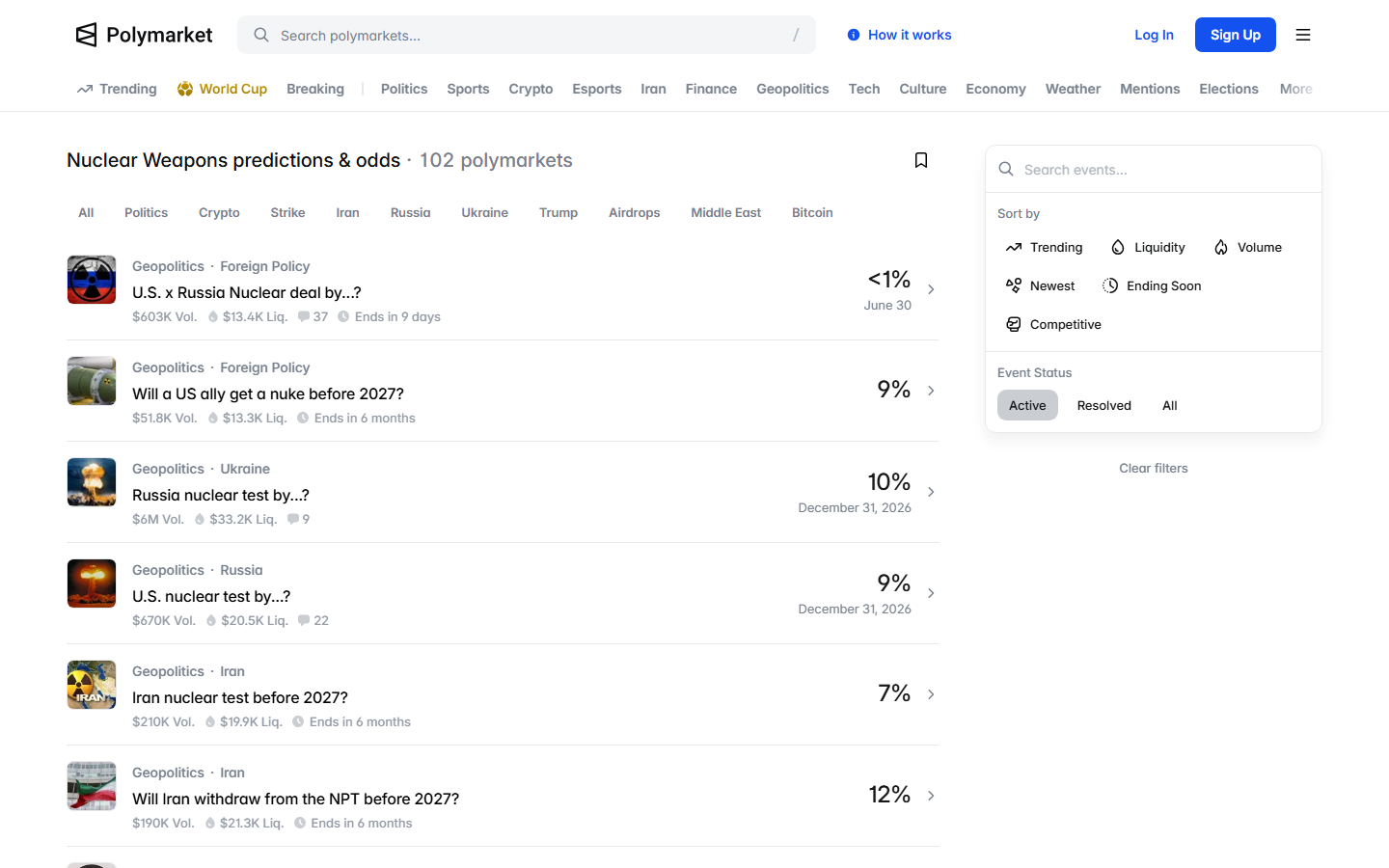
Trata cada página como un directorio, no como la respuesta. Según la revisión del 20 de junio de 2026, las páginas de Polymarket relacionadas con lo nuclear mostraban una mezcla de tipos de mercado, entre ellos:
Esa mezcla es justamente el punto. La etiqueta «armas nucleares» no te dice el evento exacto. «Nuke» puede ser aún más ruidosa. Quien se detiene en la página de categoría puede acabar comparando mercados que no deberían compararse.
Una comparación más limpia pregunta:
| Revisión | Por qué importa |
|---|---|
| Redacción exacta | Define qué significan realmente SÍ y NO |
| Actor | Irán, Rusia, EE. UU., un aliado u otro país son casos de riesgo distintos |
| Tipo de evento | Prueba, adquisición, uso, salida de un tratado, diplomacia o enriquecimiento no son intercambiables |
| Fecha de cierre | El mismo precio puede significar cosas distintas a 10 días que a 6 meses |
| Liquidez y spread | Los mercados con poca profundidad se mueven con órdenes pequeñas |
| Reglas de resolución | El mercado solo es tan claro como la evidencia que acepta |
- «¿Arma nuclear iraní antes de 2027?»
- «¿Conseguirá un aliado de EE. UU. un arma nuclear antes de 2027?»
- «¿Prueba nuclear de Rusia antes de...?»
- «¿Prueba nuclear de EE. UU. antes de...?»
- «¿Prueba nuclear iraní antes de 2027?»
- «¿Se retirará Irán del NPT antes de 2027?»
- Mercados sobre diplomacia nuclear y enriquecimiento
- Algunos resultados poco o nada relacionados bajo etiquetas de categoría amplias
1. Redacción exacta
Empieza por el verbo. ¿El mercado pregunta si un país va a probar, adquirir, usar, retirarse, atacar, acordar, anunciar, enriquecer o inspeccionar? Esos verbos hacen trabajos distintos.
Después identifica al actor. Un mercado sobre Irán no es un mercado sobre Rusia. Un mercado sobre un aliado de EE. UU. que adquiere un arma nuclear no es un mercado sobre Estados Unidos realizando una prueba nuclear.
Por último, identifica el detonante. ¿SÍ exige una confirmación oficial, una declaración de gobierno, una fuente vinculada al IAEA, un medio de comunicación concreto, una acción sobre un tratado o una redacción específica de las reglas del mercado? Si no puedes explicar la condición de SÍ en una frase, las probabilidades todavía no están listas para interpretarse.
2. Fecha de cierre
La ventana temporal cambia el significado del precio.
Un mercado que cierra en 10 días está valorando una ventana corta. Un mercado que cierra antes de 2027 valora una más larga. El mismo precio de SÍ del 7% puede significar cosas muy distintas según cuánto tiempo quede.
Esto es especialmente importante en las probabilidades sobre armas nucleares, porque muchos resultados dependen de plazos. Un acuerdo diplomático antes del 30 de junio, una prueba nuclear antes del 31 de diciembre y la salida de un tratado antes de 2027 corren en relojes distintos. Lee siempre el precio junto con la fecha.
3. Liquidez, volumen y spread
El volumen es actividad histórica. La liquidez es la profundidad actual. El spread es la distancia entre compradores y vendedores.
Los tres importan.
Un mercado puede tener un volumen acumulado impresionante y, a la vez, poca liquidez actual. También puede mostrar una probabilidad de titular que parece precisa mientras el libro de órdenes es demasiado delgado para sostener esa precisión. En mercados de predicción sobre guerra nuclear con poca liquidez, una orden pequeña puede mover el precio con fuerza sin que eso demuestre que la probabilidad real haya cambiado.
Un mercado útil suele tener: Si faltan esas piezas, considera el precio como una señal débil.
- Suficiente liquidez cerca del precio actual
- Actividad reciente, no solo volumen antiguo
- Un spread entre compra y venta razonablemente estrecho
- Una conexión clara entre el movimiento del precio y la nueva información
- Un texto de reglas que los traders puedan interpretar de forma consistente
4. Reglas y fuentes de resolución
Un mercado de Polymarket solo es tan bueno como sus criterios de resolución. En los mercados relacionados con lo nuclear, las reglas importan porque términos como «nuke», «arma nuclear», «prueba nuclear», «enriquecimiento», «ataque» y «retirada» pueden interpretarse de formas distintas en el lenguaje corriente. Las reglas del mercado deciden qué cuenta.
Busca: No asumas que el titular de una noticia resuelve automáticamente un mercado. El titular puede mover el precio, pero las reglas deciden el resultado.
- La definición exacta del evento
- La fuente o fuentes usadas para la resolución
- Si los informes no oficiales cuentan
- Si el mercado exige una confirmación oficial
- Cómo se tratan los eventos ambiguos o disputados
- Si el mercado excluye eventos relacionados pero distintos
Los mercados nucleares sobre Irán son un buen ejemplo de por qué la redacción importa.
Un mercado titulado «¿Arma nuclear iraní antes de 2027?» suena amplio. Según sus reglas, puede centrarse en si Irán obtiene, usa, anuncia o se confirma que tiene un arma nuclear. No puedes saberlo solo por el título corto.
Un mercado titulado «¿Prueba nuclear iraní antes de 2027?» es más estrecho. Trata de una prueba, no necesariamente de adquisición, diplomacia, enriquecimiento o estatus de tratado.
Un mercado titulado «¿Se retirará Irán del NPT antes de 2027?» es distinto otra vez. Trata de una acción sobre un tratado. Puede moverse con noticias de política nuclear, pero no es lo mismo que un mercado sobre una prueba nuclear o sobre un arma nuclear.
Un lector disciplinado los separa:
Misma área temática. Mercado distinto. Probabilidades distintas.
- Mercado «nuke»: revisa qué significa «nuke» en las reglas.
- Mercado «prueba nuclear»: revisa qué cuenta como prueba y qué confirmación se exige.
- Mercado «salida del NPT»: revisa los criterios de acción sobre el tratado y las fuentes aceptadas.
Tratar la etiqueta de la categoría como el mercado
Una página de categoría ayuda a descubrir mercados, pero puede agruparlos de forma laxa. Entra y lee la pregunta concreta.
Leer el precio sin mirar la liquidez
Un precio de SÍ del 7% no es igual de significativo en todos los mercados. La liquidez, el spread y la actividad deciden cuánto peso merece el número.
Ignorar la fecha de cierre
Un precio bajo en una ventana corta y un precio bajo en una ventana larga no tienen el mismo significado.
Tratar Polymarket como una certeza
Los precios de los mercados de predicción son señales. Pueden ser útiles, pero no son pronósticos oficiales, consenso de expertos ni resultados garantizados.
Operar el titular en lugar de las reglas
Un titular dramático puede captar atención. El mercado sigue resolviéndose según sus propios criterios.
Predicts.Guru es útil cuando quieres leer los mercados nucleares de Polymarket con más contexto que el precio del titular. En mercados como los de armas nucleares de Polymarket, el arma nuclear iraní en Polymarket y las páginas más amplias del mercado nuke de Polymarket, el trabajo importante no es solo mirar el porcentaje. Es seguir cómo cambian el precio, la liquidez, el volumen, la actividad del mercado, el texto de las reglas y el comportamiento de las carteras alrededor de los eventos.
Eso ayuda a responder preguntas prácticas: Usa Predicts.Guru como una capa de investigación, no como una orden de operar. El objetivo es entender el mercado antes de apoyarte en él.
- ¿El mercado se movió por noticias reales o por un flujo de órdenes escaso?
- ¿La liquidez mejoró o desapareció?
- ¿Los traders reaccionan a una fuente que importa para la resolución?
- ¿El título del mercado es más amplio que las reglas reales?
- ¿Hay carteras grandes cambiando la señal visible?
Los precios de Polymarket pueden ser informativos, pero tienen límites.
Los precios de mercado no son certeza. Poca liquidez puede distorsionar una probabilidad. Los lectores ocasionales pueden interpretar las reglas de forma distinta. El acceso a la plataforma y el tratamiento legal varían según la jurisdicción. Operar implica riesgo, incluida una pérdida sustancial.
Este artículo es para interpretación e investigación de mercados. No es asesoramiento financiero, orientación profesional ni una recomendación para operar ningún mercado relacionado con lo nuclear.
¿Son precisas las probabilidades de guerra nuclear de Polymarket?
Pueden ser útiles como señal basada en el mercado, pero no son precisas de forma automática. La calidad de la señal depende de una redacción clara, liquidez suficiente, negociación activa, un spread estrecho y reglas de resolución fiables. Un mercado líquido y bien definido es más informativo que uno con poca liquidez o ambiguo.
¿Un precio de SÍ del 7% significa que la probabilidad real es exactamente 7%?
No. Un precio de SÍ de 7 centavos se traduce aproximadamente en un 7% de probabilidad implícita en un mercado binario simple, pero la probabilidad real puede ser distinta. El spread, la liquidez, las comisiones, la negociación estancada y la incertidumbre sobre las reglas pueden afectar a la utilidad de ese número.
¿Un mercado sobre un arma nuclear iraní es igual que uno sobre una prueba nuclear iraní?
No. Un mercado de tipo «nuke» puede definir el evento de una manera, mientras que un mercado de prueba nuclear suele preguntar por una prueba concreta antes de un plazo. Pueden reaccionar a noticias parecidas, pero no son el mismo mercado a menos que las reglas los hagan equivalentes.
Las probabilidades de guerra nuclear de Polymarket solo son útiles cuando las lees como datos de mercado con condiciones adjuntas.
Empieza por la pregunta exacta. Convierte el precio en una probabilidad implícita aproximada. Después revisa la liquidez, el spread, el volumen, la fecha de cierre y las reglas de resolución. En los mercados relacionados con lo nuclear, ese proceso importa más que la etiqueta de la categoría.
Una lectura limpia no es «el mercado dice que la guerra nuclear tiene un X% de probabilidad». Una lectura más limpia es: «este mercado concreto, con esta redacción, este plazo, esta liquidez y estas reglas, está valorando ahora mismo este evento definido en torno a un X%».
Contenido solo educativo. Verifica las reglas, comisiones, disponibilidad y detalles de resolución vigentes en la plataforma antes de actuar.
Consulta estas fuentes oficiales de Polymarket antes de actuar según condiciones de referidos, métodos de depósito, comisiones, disponibilidad, verificación o detalles de resolución.
Última verificación: 20 jun 2026
Revisa el movimiento, la liquidez, el volumen y el contexto de las reglas antes de confiar en un precio relacionado con lo nuclear.
Entiende cómo la redacción del mercado y las fuentes deciden los resultados.
Herramientas y lecturas relacionadas citadas en esta guía.
Continúa con temas cercanos de investigación en Polymarket.
Cómo los mercados de predicción de noticias convierten elecciones, tasas, fallos judiciales, novedades de empresas y titulares en probabilidades.
Aprende a convertir los precios de Polymarket en probabilidad implícita y revisa spread, liquidez, reglas y contexto de cartera antes de confiar en la señal.
Entiende las reglas de resolución de Polymarket, propuestas del oráculo UMA, periodos de impugnación, pagos ganadores, acciones perdedoras y riesgos de tiempo.