Polymarket Implied Probability: How to Convert Prices Into Market Expectations
Learn how to convert Polymarket prices into implied probability, then check spread, liquidity, rules, and wallet context before trusting the signal.
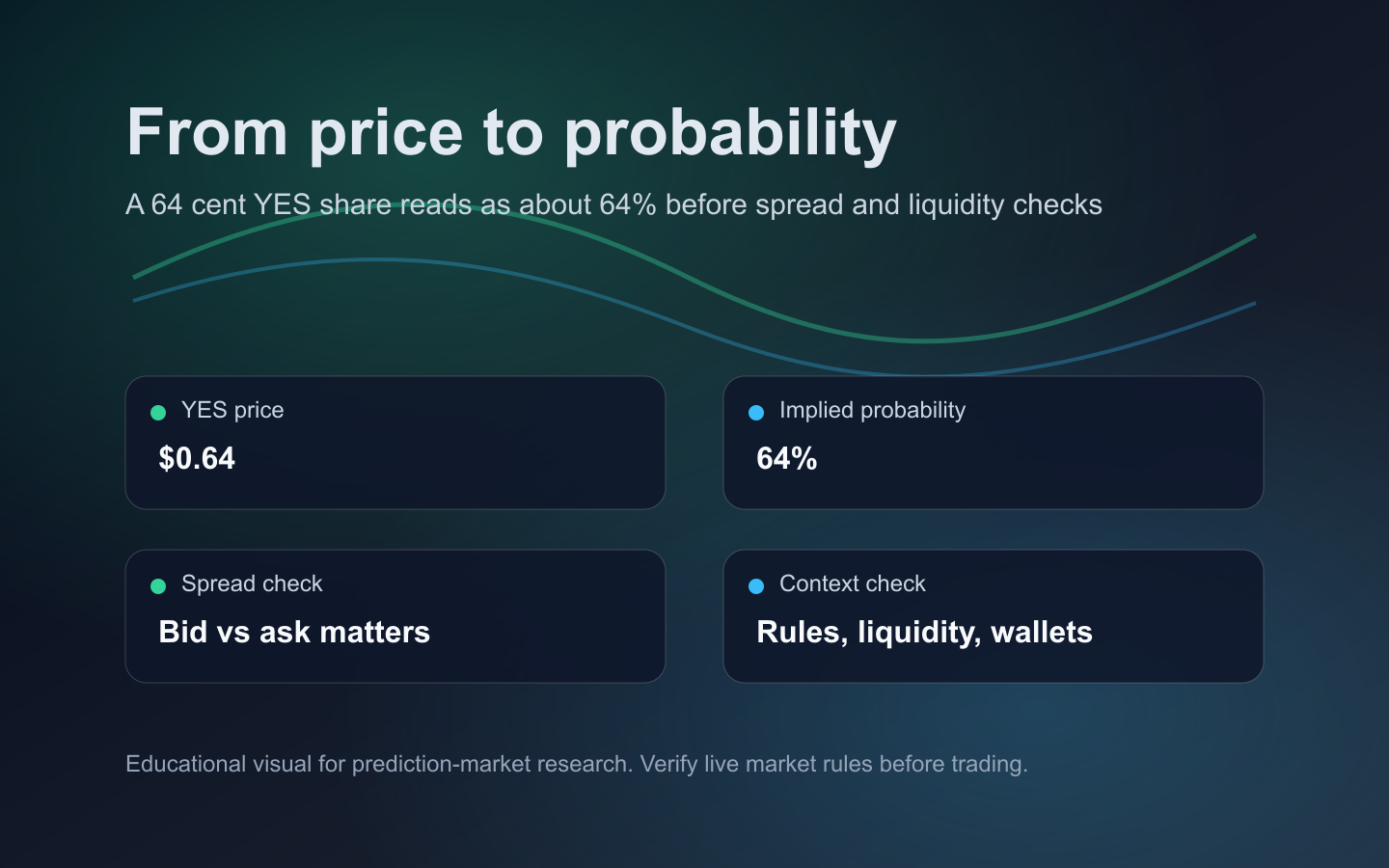
Polymarket implied probability is the current market price converted into a percentage expectation. The basic formula is: `Polymarket price in dollars x 100 = implied probability percentage`. A YES price of `$0.64` implies about a `64%` chance that the market resolves YES. Treat that number as a market signal, then check whether it deserves weight.
- Read the exact market question and resolution rules.
- Compare bid, ask, spread, liquidity, and order-book depth.
- Check recent market movement and stale last trades.
- Use Predicts.Guru to compare Polymarket probability, liquidity, spread, and leaderboard context before relying on the price.
What does Polymarket implied probability mean?
Polymarket implied probability is the current market price converted into a percentage expectation. The basic formula is: `Polymarket price in dollars x 100 = implied probability percentage`. A YES price of `$0.64` implies about a `64%` chance that the market resolves YES. Treat that number as a market signal, then check whether it deserves weight.
Polymarket prices can look simple: 64 cents means roughly 64%. If you are learning how to read Polymarket prices, that conversion gives you the first answer. The more useful question is whether the number reflects a liquid, well-defined market or a thin price that can move after one trade.
Polymarket's own documentation describes markets as binary Yes/No questions and explains that prices represent market-implied probabilities. That makes Polymarket useful for reading market expectations, but only when you understand the exact contract, the bid-ask spread, and the resolution source.
This matters if you came from a Polymarket leaderboard. A large position can look smart, but you still need to ask: Did the trader enter before the market moved? Is there enough liquidity to exit? Does the market resolve against an official source? Predicts.Guru is built for that research workflow. It lets you read the price, inspect the context, and avoid treating one headline number as the whole story.
Risk note: prediction markets involve financial risk, liquidity risk, and resolution risk. Use market prices as information, not as trading advice.
- Read the exact market question and resolution rules.
- Compare bid, ask, spread, liquidity, and order-book depth.
- Check recent market movement and stale last trades.
- Use Predicts.Guru to compare Polymarket probability, liquidity, spread, and leaderboard context before relying on the price.
How do you convert Polymarket prices into implied probability?
To convert a Polymarket YES price into implied probability, move the decimal two places. `YES price x 100 = implied YES probability` Examples:
On standard binary Polymarket markets, users trade outcome tokens. Polymarket's documentation explains that a YES token can redeem for `$1.00` if the event occurs, while a NO token can redeem for `$1.00` if the event does not occur. That payoff structure is why a price between `$0.00` and `$1.00` maps so cleanly to probability.
This conversion also helps you compare Polymarket odds with other probability formats. A 64% prediction market probability does not mean the event will happen. It means traders currently price the YES side near 64 cents before execution costs, market movement, and resolution uncertainty.
Predicts.Guru works well as a Polymarket implied probability calculator plus a context layer. You can read the current percentage, then check whether the market has the liquidity, spread, and wording quality to make that percentage useful.
| Polymarket YES price | Implied probability | Reader interpretation |
|---|---|---|
| `$0.20` | 20% | Market prices the outcome as unlikely |
| `$0.50` | 50% | Market prices the outcome near a coin flip |
| `$0.64` | 64% | Market prices the outcome as more likely than not |
| `$0.80` | 80% | Market prices the outcome as likely, but still uncertain |
- `$0.64` YES price = about `64%` implied probability.
- `$0.37` YES price = about `37%` implied probability.
- `$0.80` YES price = about `80%` implied probability.
Why can YES and NO prices fail to add up to 100%?
In a clean binary market, YES and NO should sit close to 100% combined. If YES implies 64%, NO should sit near 36%. Live markets often look less clean because you are not always seeing one frictionless price.
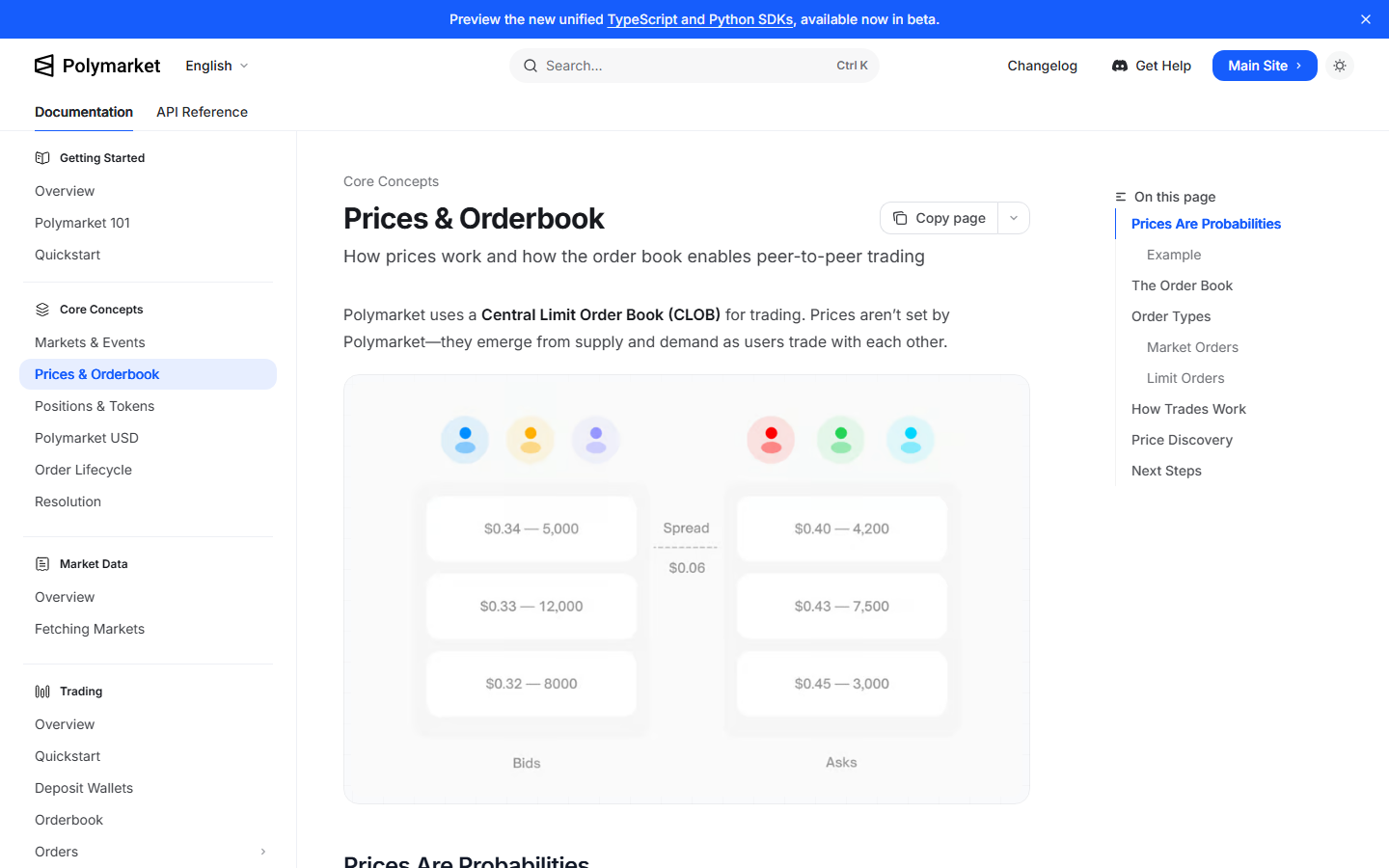
The main issue is the bid-ask spread. Polymarket's order-book documentation describes bids as prices buyers offer and asks as prices sellers accept. The spread is the gap between the best bid and best ask. A wide spread means you may see a displayed probability that differs from the price you can trade.
Example:
That `103%` total does not mean the event has more than 100% probability. It means traders are charging a spread. If you cross both asks, you pay the cost of execution.
Thin liquidity makes this problem worse. A market may show a recent price, but the order book may have little size near that level. If a small order moves the market from 37% to 44%, the new headline probability may say more about liquidity than belief.
Before reading YES plus NO as a clean probability snapshot, check:
| Side | Visible price |
|---|---|
| YES ask | `$0.64` |
| NO ask | `$0.39` |
| Combined cost to buy both asks | `$1.03` |
- Best bid and best ask, not only the last price.
- Spread size.
- Order-book depth near the current price.
- Whether recent trades are stale.
- Whether one trade caused most of the movement.
- Predicts.Guru liquidity and spread views before treating the price as a strong signal.
How should you read market expectations from a Polymarket price?
A Polymarket price reflects market expectations for one exact question. Start with the wording, then read the rules, then interpret the price.
A market asking "Will X happen by June 30?" differs from a market asking "Will X be announced by June 30?" One depends on the event itself. The other depends on a public announcement. A 64% implied probability only applies to the exact version of the question traders are pricing.
Use this 5-step reading process:
This process protects you from a common beginner mistake: converting the price correctly, then trusting the wrong market. The formula gives you the percentage. The market question tells you what that percentage refers to.
- Read the market title. Identify the event, deadline, and outcome.
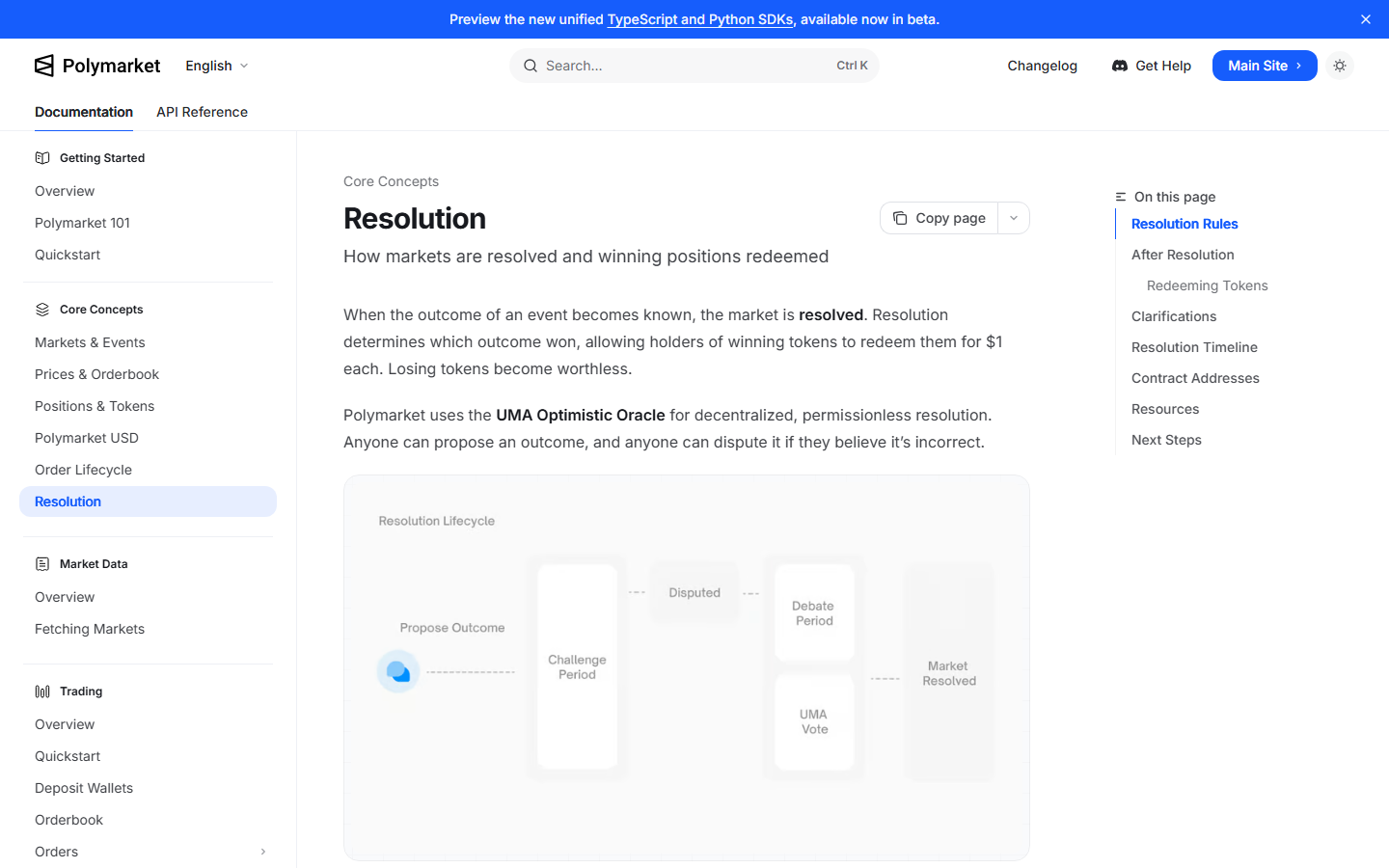
- Read the resolution rules. Polymarket's resolution documentation says market rules define the source, end date, and edge cases.
- Convert the price. `$0.64 x 100 = 64%`.
- Check the market quality. Look at spread, liquidity, volume, and recent movement.
- Compare context on Predicts.Guru. Use Predicts.Guru Polymarket analytics to see whether the number fits the market history and leaderboard activity.
Polymarket implied probability is useful when you want a fast read on how traders price a future event. It can help with politics, sports, crypto, macro, entertainment, and news markets, as long as the market has enough liquidity and a clear resolution path. Use it when:
A price chart can show whether the market moved in one sharp jump or through sustained trading. Liquidity can show whether traders have enough size behind the current level. Spread can show whether the displayed price is tight enough to matter.
Predicts.Guru is strong in this workflow because it keeps the conversion tied to the checks that make the conversion useful. You can move from "this market says 64%" to "this market says 64%, the spread is tight, the price moved after a clear catalyst, and the rules resolve against a specific source."
- You want to compare public narratives with prediction market prices.
- You need a percentage instead of vague language like "likely" or "unlikely."
- You want to track how expectations changed after news.
- You want to compare several related markets.
- You want to understand why a leaderboard trader took a visible position.
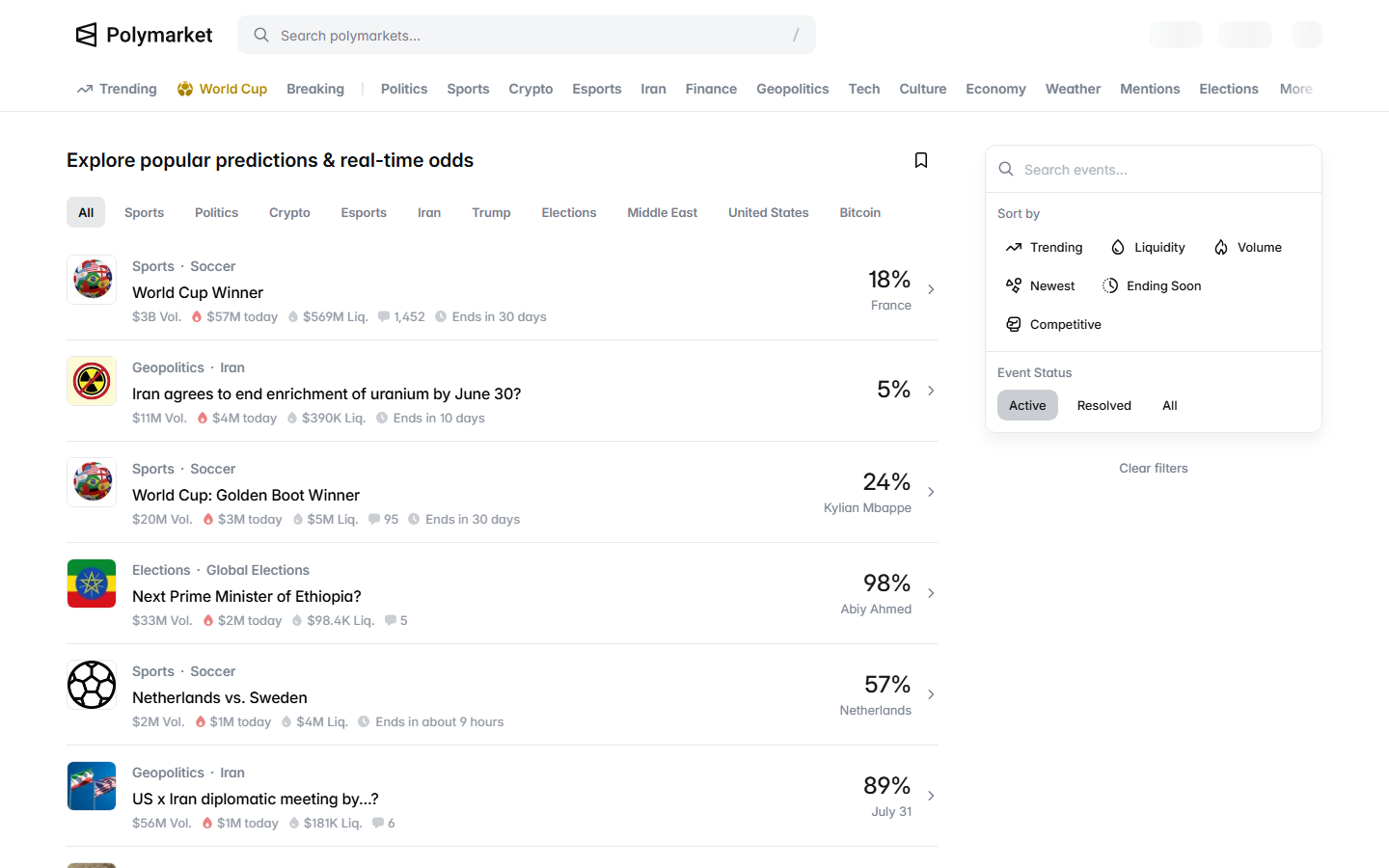
A Polymarket price can mislead you when the market is thin, vague, stale, or hard to resolve. Watch for these warning signs:
A market can also price social attention instead of durable information. Trending markets often move because users react to headlines, influencer posts, or leaderboard screenshots. That movement may still matter, but you should check whether volume and order-book depth support it.
Predicts.Guru helps here by giving you a slower, cleaner reading process. Instead of chasing a single Polymarket probability, you can inspect the market's price history, spread, liquidity, and trader context before deciding how much weight to give the signal.
- Wide spread: A 64% midpoint may hide a worse buy or sell price.
- Low liquidity: A small order can move the displayed probability.
- Stale last trade: The last price may reflect old information.
- Ambiguous wording: The market question may not match the event you care about.
- Messy resolution rules: The official source, deadline, or edge cases may create dispute risk.
- Leaderboard overreaction: A large trader position may attract attention without proving the market is reliable.
Predicts.Guru turns the basic price conversion into a practical research workflow. That matters because the hard part is not multiplying `$0.64` by 100. The hard part is deciding whether 64% deserves attention.
Use Predicts.Guru to:
For beginners, Predicts.Guru reduces confusion. For active traders, it saves time. For leaderboard watchers, it adds discipline: a profitable-looking trader profile becomes one input, not a reason to trust the price without checking the market.
Use the Predicts.Guru implied probability tools when you want the fast answer. Use Predicts.Guru Polymarket analytics when you want to know whether the fast answer is useful.
- Convert prices into probabilities. Read Polymarket implied probability without doing mental math on every market.
- Check liquidity. See whether enough size supports the current price.
- Review spread. Spot markets where the displayed price differs from a realistic execution price.
- Track movement. Compare current probability with recent market history.
- Read market wording. Keep the title, rules, and resolution context close to the price.
- Analyze leaderboard signals. See whether visible trader activity matches market quality.
- Compare related markets. Avoid judging one price in isolation.
Polymarket leaderboards can help you discover markets and traders worth studying. They can also push you toward shallow conclusions if you look only at rank, profit, or position size.
A leaderboard position tells you that someone has exposure. It does not tell you whether the current price is attractive, whether the trader has already captured most of the move, or whether the market has enough liquidity for your own size. Use this checklist before treating leaderboard activity as a signal:
A large YES position at 64% can mean several different things. The trader may have bought earlier at 37%. They may have entered a thin market. They may be hedging another position. They may be wrong. Predicts.Guru helps you separate "interesting trader behavior" from "useful market expectation."
- Check the market's current implied probability.
- Compare the trader's entry context with the current price.
- Look at liquidity and spread before assuming the position can be copied.
- Read the resolution rules.
- Check whether the market moved before or after the leaderboard activity became visible.
- Use Predicts.Guru leaderboard tools to connect trader activity with market context.
Suppose you see a market with a YES price near `$0.64`. The basic calculation says: `$0.64 x 100 = 64% implied probability`
That is the first layer. Now add context:
After those checks, 64% becomes more than a number. It becomes a market expectation with a quality score in your head. You may still disagree with the market, but you are reading it with better discipline.
| Check | What to ask |
|---|---|
| Market wording | Does the title match the event I care about? |
| Resolution rules | Which source decides the outcome? |
| Spread | Can I buy or sell near the displayed price? |
| Liquidity | Is there enough size near 64%? |
| Price movement | Did the market move after news or one small trade? |
| Leaderboard activity | Are large positions backed by a liquid market? |
| Predicts.Guru context | Does the market look reliable after all checks? |
Mistake 1: Treating 64% as certainty. A 64% implied probability still leaves a 36% implied chance for the other side in a clean binary setup. Likely events can fail.
Mistake 2: Ignoring the spread. A displayed midpoint may differ from your buy or sell price. Check bid and ask before you treat the displayed probability as tradable.
Mistake 3: Skipping the resolution rules. A market resolves according to its rules, not your interpretation of the headline. Read the source, deadline, and edge cases.
Mistake 4: Overreading leaderboards. A visible trader may have a different entry, size, hedge, or time horizon. Use Predicts.Guru leaderboard context before copying the story you want to see.
Mistake 5: Comparing unrelated markets. Two markets can look similar while resolving on different wording. Compare only after you read the exact question.
Is Polymarket price the same as probability?
Polymarket price is a market-implied probability, not an objective probability. A `$0.64` YES price means traders price the YES outcome near 64%. The number can be distorted by spread, liquidity, stale trades, fees, and resolution risk.
How do I calculate implied probability from Polymarket odds?
Multiply the Polymarket price by 100. A `$0.25` YES price implies 25%. A `$0.50` YES price implies 50%. A `$0.75` YES price implies 75%. Use Predicts.Guru when you want the probability plus liquidity, spread, and market context.
Why does Polymarket show different buy and sell prices?
Buyers and sellers meet through an order book. The best bid is what buyers will pay. The best ask is what sellers will accept. The gap between them is the spread. Wider spreads make the displayed probability less useful as an execution price.
Can Polymarket implied probability predict the future?
Polymarket implied probability shows how traders price an outcome at a point in time. It can be informative, especially in liquid markets, but it does not guarantee the future. Treat it as one signal and compare it with official sources, market rules, and Predicts.Guru analytics.
What should I check before trusting a Polymarket leaderboard?
Check the market behind the leaderboard position. Look at implied probability, spread, liquidity, price movement, entry context, and resolution rules. Predicts.Guru leaderboard tools help you connect trader activity to the market conditions that make the signal stronger or weaker.
Polymarket implied probability is easy to calculate: price times 100. A `$0.64` YES price means about 64%. That answer helps, but it is only the start.
The better workflow is: convert the price, read the market question, check resolution rules, inspect spread and liquidity, review price movement, and compare leaderboard activity with market quality. Predicts.Guru gives you that workflow in one place, making Polymarket prices easier to read and harder to overinterpret. Use Predicts.Guru when you want to move from a raw Polymarket price to a market expectation you can evaluate with more context.
Educational content only. Verify live platform rules, fees, availability, and market resolution details before acting.
Check these official Polymarket sources before you act on referral terms, deposit methods, fees, availability, verification, or resolution details.
Last verified: Jun 19, 2026
Check spread, liquidity, rules, and recent activity before relying on a price.
Learn how Polymarket shares map to prices and payouts.
Tools and related reading referenced by this guide.
Continue with nearby Polymarket research topics.
Understand Polymarket Yes and No shares, market prices, implied probability, payout math, early selling, liquidity, and beginner risks.
Learn how betting on Polymarket works through Yes/No shares, prices, probability, liquidity, order books, settlement, and trader research.
Understand Polymarket resolution rules, UMA oracle proposals, challenge periods, winning payouts, losing shares, and timing risks.