
Guía de las elecciones 2028 en Polymarket: cómo leer el mercado de la próxima presidencia de EE. UU. con las lecciones de 2024
Usa el mercado electoral 2028 de Polymarket como señal estructurada: revisa precio, spread, liquidez, volumen, tenedores y reglas de resolución.
Lee el mercado de las elecciones 2028 de Polymarket como una señal temprana, no como un pronóstico en el que confiar por sí solo. Antes de reaccionar a las probabilidades de un candidato, revisa la pregunta exacta, la regla de resolución, los precios de Sí/No, el spread, la liquidez, el volumen, los principales tenedores, la actividad de ballenas y cuándo se capturaron los datos.
- Los precios electorales del inicio del ciclo pueden reflejar especulación, atención y posicionamiento de carteras grandes.
- El mercado de 2024 es contexto útil, pero la liquidez y la estructura de candidatos de 2028 deben revisarse de nuevo.
- El precio, el spread, la liquidez y el comportamiento de los principales tenedores deben leerse juntos.
- Usa las herramientas de Predicts.Guru para inspeccionar el movimiento del mercado y las carteras antes de confiar en capturas de pantalla electorales.
¿Cómo deberías leer el mercado electoral 2028 de Polymarket?
Lee el mercado de las elecciones 2028 en polymarket como una señal temprana, no como un pronóstico en el que confiar por sí solo. El precio de un candidato puede parecer simple, pero las probabilidades del inicio del ciclo son menos fiables que las del final del ciclo o las de la noche electoral, salvo que la liquidez, el spread y el volumen respalden la señal. Antes de reaccionar, revisa:
Usa 2024 como caso de estudio: los cambios de candidatos, los debates, la atención mediática, los grandes traders y los datos de la noche electoral moldearon la forma en que se movieron los precios de Polymarket.
- La pregunta exacta del mercado y su regla de resolución
- Los precios de Sí/No actuales, el spread, la liquidez y el volumen reciente
- Los cambios en la lista de candidatos y si los resultados siguen siendo realistas
- Los principales tenedores, la actividad de ballenas y el historial relevante de carteras
- La fecha y hora en que se revisaron los datos
Por qué el mercado 2028 debe leerse a través del caso de estudio de 2024
Polymarket hizo que las probabilidades electorales fueran fáciles de seguir en 2024. Un candidato que cotizaba a 60 centavos parecía tener una probabilidad implícita del 60% según el mercado. Eso era útil, pero era solo la primera capa.
La mejor pregunta era: ¿cuánta información había detrás de ese precio?
Un precio del 55% en un mercado profundo de noche electoral, con volumen alto, spreads estrechos, contrapartes activas y reacciones rápidas, significa algo distinto de un precio del 55% dos años antes de las primarias. Los precios tempranos de 2028 pueden reflejar reconocimiento de nombre, narrativas mediáticas, posicionamiento especulativo, operaciones de ballenas y apuestas de baja convicción. Aun así pueden ser útiles, pero solo si los lees con disciplina.
El mercado de las elecciones presidenciales de 2024 en Polymarket es el mejor punto de referencia. Polymarket mostró cerca de $3.686 mil millones de volumen para ese evento, con Donald Trump resolviendo como el resultado ganador y Kamala Harris convirtiéndose en uno de los mayores mercados de resultado perdedor. Un artículo académico de 2026 sobre el mercado electoral 2024 de Polymarket también identificó la retirada de Biden, el debate de septiembre y el episodio del trader ballena de octubre como fases importantes del mercado.
Este artículo es una guía de investigación, no asesoramiento financiero, consejos de apuestas, orientación profesional ni un pronóstico partidista.
Lo que ya muestra la página de las elecciones presidenciales 2028 en Polymarket
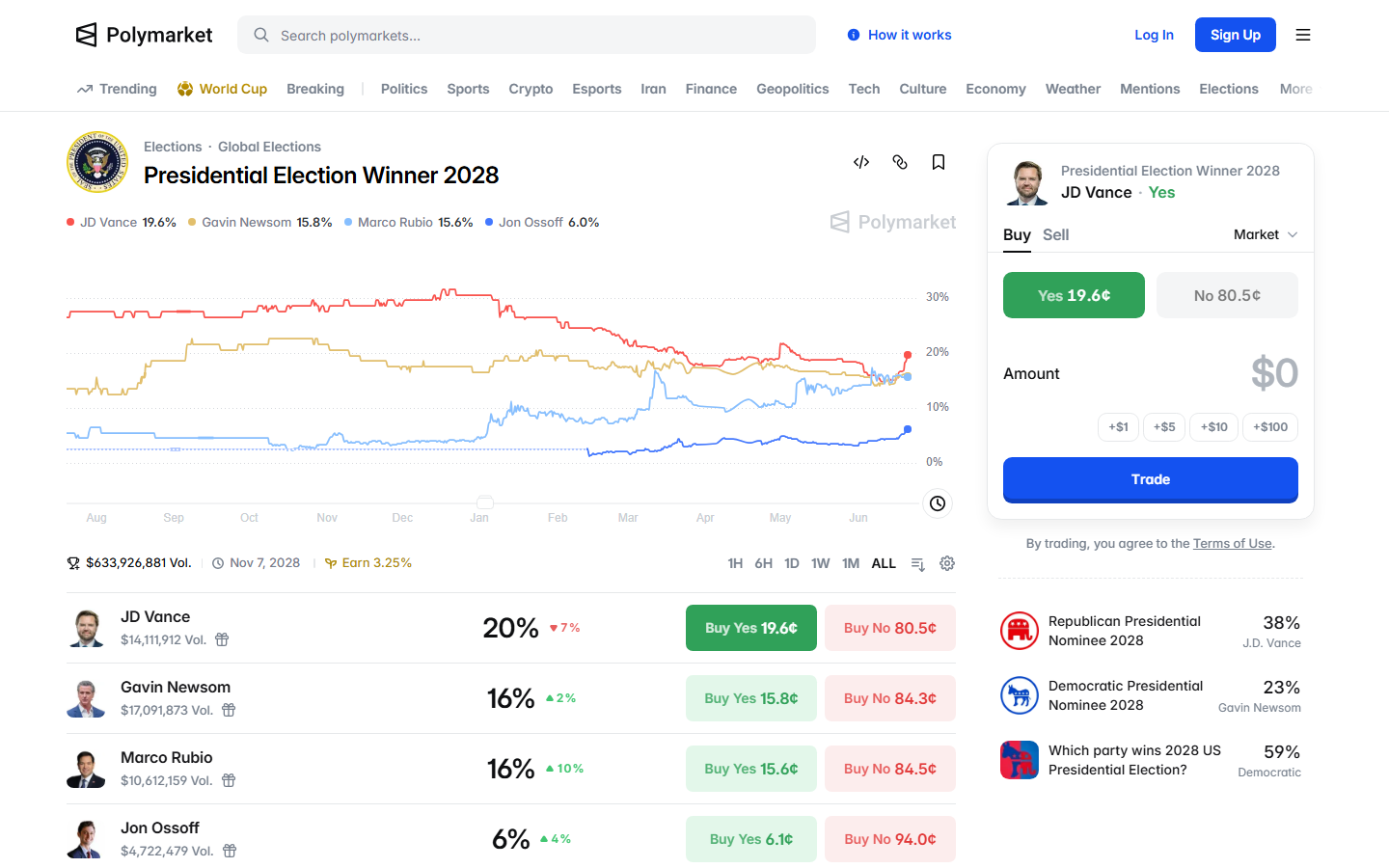
El mercado de las elecciones presidenciales 2028 en Polymarket actual se titula «Presidential Election Winner 2028» en el concepto del evento, y la página en ruso se muestra como «Победитель президентских выборов 2028 года». Snapshot revisado: 20 de junio de 2026. En ese momento, la página mostraba un mercado con múltiples candidatos, con nombres como JD Vance, Gavin Newsom, Marco Rubio, Alexandria Ocasio-Cortez, Kamala Harris, Jon Ossoff, Josh Shapiro, Tucker Carlson, Donald Trump, Ron DeSantis, Pete Buttigieg, Andy Beshear, Elon Musk, Nikki Haley, Wes Moore, Glenn Youngkin, Tulsi Gabbard y Vivek Ramaswamy.
El mismo snapshot mostraba:
La regla de resolución es más importante que la lista de candidatos. Polymarket indica que el mercado se resuelve a favor de la persona que gane las elecciones presidenciales de EE. UU. de 2028. Las fuentes listadas son Associated Press, Fox News y NBC. El mercado se resuelve cuando las tres declaran ganador al mismo candidato. Si no han declarado todas al mismo candidato antes del 20 de enero de 2029, el mercado se resuelve según quién asuma el cargo.
Como las páginas de Polymarket se actualizan, vuelve a revisar la página del evento antes de publicar, operar o citar un precio.
| Campo | Valor del snapshot | Por qué importa |
|---|---|---|
| Evento | Presidential Election Winner 2028 | Confirma que estás leyendo el mercado principal de ganador |
| Volumen total | Unos $576.0 millones | Contexto útil, pero no es lo mismo que la liquidez actual |
| Fecha de cierre | 7 de noviembre de 2028 | Coincide con la fecha electoral prevista |
| Apertura del mercado | 11 de julio de 2025, 2:44 PM ET | Muestra cuánto tiempo lleva formándose el precio del inicio del ciclo |
| Candidatos destacados mostrados | JD Vance, Gavin Newsom, Marco Rubio, AOC | Muestra las expectativas del mercado en un momento dado |
| Fuentes de resolución | Associated Press, Fox News, NBC | Define qué evidencia liquida el mercado |
| Regla alternativa | Toma de posesión el 20 de enero de 2029 | Cubre el caso en que las fuentes listadas no declaren todas al mismo ganador |
Qué copiar antes de interpretar cualquier probabilidad electoral de Polymarket
Antes de leer el precio, copia los datos brutos del mercado en tus notas. Esto evita un error común: reaccionar a una probabilidad de titular sin saber qué pregunta realmente el mercado. Usa esta lista de verificación:
Para las elecciones presidenciales de 2028, la fecha de revisión importa. Un precio en junio de 2026, en temporada de primarias, en temporada de convenciones, a finales de octubre de 2028 y en la noche electoral puede significar cosas muy distintas.
- URL y slug del mercado
- Título del mercado
- Resultado del candidato
- Precios actuales de Sí y No
- Spread entre los precios de compra y de venta
- Volumen total
- Volumen reciente, como el volumen de 24 h o 7 d si está disponible
- Liquidez y profundidad visible del libro de órdenes
- Mayores mercados de resultado
- Principales tenedores
- Fecha de apertura del mercado
- Fecha de cierre
- Fuentes de resolución
- Regla alternativa de toma de posesión
- Captura de pantalla o nota con fecha
- Fecha y hora en que revisaste los datos
Los precios de Polymarket suelen cotizar entre $0 y $1. En una lectura simple, una acción de Sí a $0.64 significa que el mercado implica una probabilidad de aproximadamente el 64% de que ocurra el resultado. Si el resultado se resuelve como Sí, la acción paga $1. Si se resuelve como No, paga $0.
Eso no significa que el evento tenga una probabilidad real del 64% en el mundo real. Significa que compradores y vendedores están cerrando operaciones actualmente en torno a ese precio.
En un mercado de elecciones presidenciales, cada resultado de candidato funciona como un derecho sobre la victoria de ese candidato. Un candidato con precio de 18 centavos no es alguien de quien «se espera que gane» en el sentido mediático habitual. Significa que los traders valoran actualmente ese resultado en torno al 18% antes de considerar el spread, la liquidez, las comisiones, el slippage y la estructura del mercado.
Tres comprobaciones importan de inmediato: El precio de un mercado de predicción es una señal, no una certeza. Axios planteó lo mismo durante la carrera de 2024, cuando los mercados de predicción y los analistas políticos divergieron: incluso una probabilidad implícita del 60% deja un lado perdedor muy real del 40%.
- Probabilidad implícita: ¿qué sugiere el precio del Sí?
- Calidad de ejecución: ¿puedes realmente comprar o vender cerca de ese precio mostrado?
- Certeza de resolución: ¿la regla del mercado define con claridad qué cuenta como ganar?
La probabilidad de titular es el primer número que la gente ve. No siempre es el número más importante.
Un mercado poco profundo puede moverse con fuerza por un solo comprador. Un mercado profundo suele necesitar más dinero para moverse. Por eso la liquidez y el spread de Polymarket pueden importar tanto como las probabilidades.
Busca: Un candidato al 20% con un libro profundo puede ser más informativo que un candidato al 25% con un spread amplio y poca operativa reciente. Para los mercados tempranos de 2028, esta distinción es especialmente importante porque el reconocimiento de nombre puede generar atención antes de que exista información real de campaña.
- Spread estrecho: los precios de compra y de venta están cerca entre sí.
- Profundidad real: hay órdenes significativas más allá de la primera línea.
- Volumen reciente: el mercado ha operado hace poco, no solo hace meses.
- Actividad en ambos lados: hay compradores y vendedores presentes.
- Precios estables tras las noticias: el mercado absorbe información sin saltos erráticos.
El ciclo electoral 2024 en Polymarket fue útil porque mostró cómo se comportan los mercados políticos cuando el flujo de noticias se vuelve intenso. La lección no es «Polymarket siempre tiene razón». La lección es que los mercados necesitan contexto.
El reemplazo de un candidato puede cambiar todo el mapa
Joe Biden se retiró de la carrera de 2024 el 21 de julio de 2024 y respaldó a Kamala Harris. Eso no afectó solo a una línea de candidato. Cambió la estructura del mercado del lado demócrata, el planteamiento de Trump frente al nominado demócrata y la forma en que los traders valoraban los escenarios de reemplazo.
Para 2028, vigila la misma categoría de eventos: No trates una lista temprana de candidatos como definitiva. El ciclo 2024 demostró que el resultado de mercado más importante puede ser el que cambia el tablero.
- Un candidato que decide no presentarse
- Un favorito de las primarias que se debilita
- Un nuevo candidato que entra con apoyo serio de donantes o del partido
- Problemas legales, de salud, de edad, de elegibilidad o de reglas del partido
- Incertidumbre sobre la convención o los delegados
Los debates pueden mover mercados, pero la reacción es lo que importa
La carrera de 2024 incluyó el debate Biden-Trump de junio y el debate Trump-Harris de septiembre. Un estudio de 2026 a nivel de transacciones sobre el mercado presidencial 2024 de Polymarket identificó el debate de septiembre como uno de los episodios principales que moldearon la actividad de negociación. Para 2028, no preguntes solo quién «ganó» un debate. Pregunta cómo respondió el mercado:
Un titular sobre un debate puede crear ruido. Un movimiento de precio respaldado por volumen, profundidad y confirmación de mercados relacionados es más útil.
- ¿El precio se movió de inmediato y luego retrocedió?
- ¿El volumen aumentó después del debate?
- ¿La liquidez se profundizó o desapareció?
- ¿Los principales tenedores sumaron exposición o la redujeron?
- ¿Los mercados relacionados se movieron en la misma dirección?
La noche electoral es un mercado distinto de la especulación del inicio del ciclo
Las probabilidades de Polymarket en la noche electoral no son lo mismo que las probabilidades tempranas de 2028. En la noche electoral, los traders reaccionan a los recuentos de votos, las declaraciones por estado, los datos de participación, los patrones a nivel de condado y las proyecciones de los medios. Los mercados del inicio del ciclo reaccionan más a las expectativas, las narrativas, las encuestas, la recaudación de fondos, la visibilidad de los candidatos y el posicionamiento de los traders.
Esa diferencia importa.
Un precio del 70% a finales de 2028, después de que se hayan declarado estados importantes, no es el mismo tipo de señal que un precio del 70% en 2026. Ambos son precios de mercado. No cargan el mismo peso informativo.
Las operaciones de ballenas pueden volverse parte de la historia
Los grandes traders pasaron a formar parte de la conversación sobre los mercados de predicción en 2024. Axios informó en octubre de 2024 que las apuestas grandes podían mover la percepción, especialmente donde la liquidez no era lo bastante profunda para absorberlas con facilidad. El estudio académico de 2026 también trató el episodio de la cuenta grande de octubre como una parte importante del desarrollo del mercado.
Para quienes buscan clasificaciones de polymarket, la lección es simple: vale la pena estudiar a un trader grande, pero no copiarlo a ciegas. Revisa:
El puesto en la clasificación no equivale a fiabilidad. Una cuenta destacada puede ir demasiado pronto, equivocarse, tener suerte, estar sobreexpuesta u operar por motivos que no puedes ver.
- ¿La cartera tiene un historial largo o una única apuesta concentrada?
- ¿Ha operado antes en mercados electorales?
- ¿Construye posiciones de forma gradual o persigue titulares?
- ¿Está sumando cuando la liquidez es escasa?
- ¿Otras carteras serias están tomando el lado contrario?
- ¿La cartera es rentable en muchos mercados o solo en un evento público?
Usa este proceso siempre que abras la página de las elecciones 2028 en Polymarket.
1. Lee primero la pregunta exacta
No empieces por el precio. Empieza por la pregunta del mercado.
Para el mercado presidencial 2028, la pregunta clave es quién gana las elecciones presidenciales de EE. UU. Eso parece obvio, pero los mercados electorales pueden diferir de formas importantes:
Esos son mercados distintos. Confundirlos lleva a un análisis malo.
- Ganador de las elecciones generales
- Nominado del partido
- Ganador del voto popular
- Ganador de un estado
- Margen del Colegio Electoral
- Candidato que se retira
- Candidato que asume el cargo
2. Revisa la regla de resolución
La resolución decide sobre qué paga realmente el mercado. Para el mercado de ganador 2028, Polymarket lista AP, Fox News y NBC como fuentes, con una regla alternativa de toma de posesión si las fuentes no declaran todas al mismo candidato antes del 20 de enero de 2029.
Esa regla importa porque el precio de un mercado solo es útil si entiendes la vía de liquidación. En elecciones ajustadas, los recuentos, las declaraciones disputadas, la certificación retrasada y los escenarios de toma de posesión pueden importar.
3. Compara el precio con el spread
Un precio mostrado puede no ser el precio al que puedes ejecutar.
Si un candidato muestra 18.8 centavos para comprar Sí y 81.3 centavos para comprar No, deberías revisar el spread implícito y la profundidad detrás de cada cotización. Un spread amplio te dice que el mercado es menos eficiente en ese momento. Un spread estrecho te dice que compradores y vendedores están más cerca de un acuerdo.
4. Separa el volumen total de la liquidez actual
El volumen total te dice cuánta operativa ha habido a lo largo del tiempo. La liquidez actual te dice cuánto tamaño puede absorber el mercado ahora.
Un mercado puede mostrar un gran volumen histórico y aun así tener poca profundidad a un precio concreto. Para los mercados electorales, esto importa porque el volumen antiguo pudo producirse en condiciones muy distintas. Pregunta:
- ¿Cuánto se puede comprar antes de que el precio se mueva?
- ¿Cuánto se puede vender sin un slippage grande?
- ¿El volumen reciente está subiendo o desvaneciéndose?
- ¿Las órdenes están agrupadas a un solo precio o repartidas entre niveles?
6. Revisa los principales tenedores y las carteras
Los principales tenedores pueden ayudar a explicar la estructura del mercado. También pueden engañarte si los tratas como señales sin contexto. Usa el análisis de carteras para responder:
Aquí es donde Predicts.Guru Checker resulta útil. En lugar de juzgar a un trader por una captura de pantalla o una publicación en redes, revisa el historial de mercados, las posiciones, los resultados realizados y el comportamiento de la cartera pública en distintos eventos.
- ¿Quién tiene la mayor exposición al Sí?
- ¿Quién tiene la mayor exposición al No?
- ¿La cartera entró antes o después del movimiento de precio?
- ¿La cartera opera en ambos lados o solo en una narrativa?
- ¿La cartera está activa en mercados de política, deportes, cripto y macro?
- ¿La cartera ha sido rentable en mercados comparables?
Polymarket es el lugar de negociación. Predicts.Guru debe usarse como la capa de investigación en torno al mercado. Para las elecciones presidenciales de 2028, el flujo de trabajo útil es:
Usa Predicts.Guru Event Analytics cuando quieras entender cómo se movió un mercado electoral, no solo dónde cotiza ahora. Usa Checker cuando veas una cartera pública, el apodo de un trader, un perfil de la clasificación o una captura viral y quieras saber si la cuenta tiene un historial relevante.
El objetivo no es encontrar a alguien a quien copiar. El objetivo es entender si un movimiento del mercado tiene respaldo real.
| Tarea | Qué revisar en Predicts.Guru | Por qué ayuda |
|---|---|---|
| Entender el evento | Event Analytics | Ver el movimiento, el contexto de volumen y el comportamiento de mercados relacionados |
| Leer el mercado de un candidato | Páginas de mercado | Comparar precio, liquidez, volumen y contexto de reglas |
| Investigar una cartera | Checker | Revisar el historial público de la cartera antes de confiar en un trader |
| Estudiar cuentas grandes | Analítica de traders | Ver si la exposición está concentrada o es repetible |
| Comparar usuarios activos | Clasificaciones | Encontrar traders activos y luego verificarlos en lugar de copiarlos |
| Vigilar la actividad de ballenas | Vistas de principales tenedores y carteras | Identificar si un movimiento es amplio o lo impulsan unas pocas cuentas |
Las probabilidades electorales de un mercado de predicción no son encuestas. Las encuestas preguntan a muestras de votantes cómo planean votar. Los precios de Polymarket reflejan dónde los traders están dispuestos a comprar y vender acciones de resultado.
Ambas cosas pueden ser útiles. Ambas pueden equivocarse. Usa esta comparación:
Si Polymarket diverge de las encuestas, no supongas que Polymarket es más listo. Tampoco descartes la divergencia de forma automática. Pregunta qué podrían estar valorando los traders que las encuestas no captan, y si el mercado tiene suficiente profundidad para que esa señal sea significativa.
| Señal | Qué mide | Debilidad principal |
|---|---|---|
| Encuestas | Preferencia declarada de los votantes | Error de muestreo, supuestos de participación, momento |
| Modelos de pronóstico | Probabilidad electoral modelada | Supuestos del modelo, datos de encuestas, incertidumbre |
| Narrativas mediáticas | El relato público sobre la carrera | Sesgo de recencia, encuadre partidista, incentivos |
| Probabilidades de Polymarket | Precio cerrado entre traders | Liquidez, impacto de ballenas, límites de acceso, estructura del mercado |
| Analítica de Predicts.Guru | Contexto sobre precio, volumen, carteras y movimiento | Depende de los datos públicos de mercado disponibles |
Ten cuidado cuando veas cualquiera de estos patrones: El hábito más seguro es simple: revisa la pregunta exacta y luego comprueba si el mercado tiene suficiente liquidez y actividad reciente para que el precio sea informativo.
- Un movimiento de precio grande con poco volumen reciente
- Un precio de candidato alto con un spread amplio
- Una narrativa de mercado basada en una sola publicación viral
- Un candidato que sube sin que los mercados relacionados lo confirmen
- Concentración de principales tenedores en unas pocas carteras
- Volumen antiguo usado para insinuar profundidad actual
- Afirmaciones de que el precio de un mercado es un pronóstico garantizado
- Capturas de pantalla sin marcas de tiempo
- Perfiles de la clasificación promocionados sin historial de cartera
- Supuestos legales o de acceso planteados con demasiada seguridad
El mercado 2028 puede moverse antes de las elecciones generales porque los traders valorarán el camino mucho antes de que los votantes emitan su voto. Vigila estas categorías:
Decisiones de los candidatos
Los anuncios, las retiradas, los problemas de salud, las dudas sobre elegibilidad, el apoyo de donantes y los respaldos del partido pueden mover las probabilidades de un candidato.
Encuestas de primarias y estados iniciales
Iowa, New Hampshire, Carolina del Sur, Nevada y el Súper Martes pueden reconfigurar las probabilidades de nominación. El mercado del ganador presidencial puede moverse antes de que se resuelva el mercado de la nominación si los traders creen que un candidato es más elegible.
Debates y momentos mediáticos
Los debates pueden afectar la viabilidad de un candidato, pero la reacción del mercado debe contrastarse con el volumen y la liquidez.
Contexto legal y regulatorio
El acceso a los mercados de predicción y sus reglas varían según la jurisdicción. La orden de la CFTC de 2022 contra Polymarket sigue siendo parte del contexto regulatorio para los lectores de EE. UU. No des por fijos el acceso a la plataforma, la disponibilidad de mercados ni las reglas de los contratos de eventos.
Mecánica electoral
Las encuestas en estados ajustados, el voto por correo, las reglas de recuento, los plazos de certificación y los procedimientos de declaración de los medios pueden afectar cómo operan los mercados cerca de la noche electoral.
Actividad de ballenas y de la clasificación
Las carteras grandes pueden mover precios, sobre todo cuando la profundidad es débil. Usa las clasificaciones como herramienta de descubrimiento, no como atajo de confianza.
Supón que un candidato cotiza en torno al 20% en el mercado del ganador presidencial 2028. Una lectura pobre sería: «El mercado dice que esta persona tiene una probabilidad de una entre cinco de llegar a presidente». Una lectura mejor sería:
Esa segunda lectura es más lenta, pero más útil. El objetivo no es complicar las probabilidades. El objetivo es evitar tratar un solo número como si fuera toda la historia.
- ¿Cuál es el precio exacto del Sí y el precio de venta?
- ¿Qué tan amplio es el spread?
- ¿Cuánta liquidez hay cerca del precio mostrado?
- ¿El volumen reciente aumentó o se desvaneció?
- ¿El movimiento siguió a un evento, una encuesta, un debate o una noticia reales?
- ¿Los mercados de nominación confirman el movimiento?
- ¿Los principales tenedores están sumando, reduciendo o inactivos?
- ¿El candidato tiene un camino plausible por las primarias y las generales?
- ¿Qué dice la regla de resolución si la elección se disputa o se retrasa?
¿El mercado electoral 2028 de Polymarket es un pronóstico?
Es una probabilidad implícita del mercado, no un pronóstico garantizado. Los traders compran y venden acciones de resultado, y el precio refleja el nivel de cierre actual entre compradores y vendedores. Puede ser informativo, pero también puede distorsionarse por baja liquidez, spreads amplios, grandes traders o narrativas temporales.
¿Por qué usar 2024 para entender 2028?
Las elecciones de 2028 aún están lejos, así que las probabilidades en vivo por sí solas no explican mucho. El mercado electoral 2024 de Polymarket mostró cómo reaccionaron los precios a eventos políticos reales: la retirada de Biden, Harris reemplazándolo como nominada demócrata, los debates, los grandes traders, la cobertura mediática y la información de la noche electoral. Esas lecciones ayudan a los lectores a interpretar el próximo ciclo.
¿Qué es más importante: el precio, el volumen o la liquidez?
El precio es el titular. El volumen muestra la actividad pasada. La liquidez muestra cuánto tamaño puede manejar el mercado ahora. Para los mercados electorales tempranos, la liquidez y el spread suelen importar tanto como el precio, porque los mercados poco profundos pueden moverse con fuerza sin una convicción amplia.
¿Debería copiar a los traders de la clasificación de Polymarket?
No. Usa las clasificaciones para descubrir carteras activas y luego verifica el historial del trader. Un puesto alto puede venir de una sola gran ganancia, de un riesgo concentrado o de un mercado que quizá no se repita. Revisa el historial de la cartera, la selección de mercados, el momento de las posiciones y el rendimiento en varios eventos.
¿Dónde puedo analizar carteras y mercados electorales de Polymarket?
Usa Polymarket para la página del mercado y las reglas de resolución. Usa Predicts.Guru como capa de investigación: Event Analytics para el movimiento del mercado, Checker para revisar carteras, la analítica de traders para el comportamiento de cuentas públicas y las clasificaciones para encontrar traders activos que merezcan investigación.
La mejor manera de leer el mercado de las elecciones 2028 en polymarket es tratarlo como información estructurada, no como un atajo hacia la certeza.
Empieza por la pregunta exacta. Lee la regla de resolución. Revisa los precios de Sí/No, el spread, la liquidez, el volumen, el movimiento reciente, los principales tenedores y los mercados relacionados. Después usa 2024 como modelo mental: los mercados electorales pueden volverse muy informativos cuando la liquidez se profundiza y llegan eventos reales, pero los precios del inicio del ciclo también pueden reflejar especulación, atención y posicionamiento de carteras grandes.
Usa el precio del mercado como una señal, no como una conclusión.
Solo contenido educativo. Verifica las reglas vigentes de la plataforma, las comisiones, la disponibilidad y los detalles de resolución del mercado antes de actuar.
Consulta estas fuentes oficiales de Polymarket antes de actuar según condiciones de referidos, métodos de depósito, comisiones, disponibilidad, verificación o detalles de resolución.
Última verificación: 20 jun 2026
Revisa el movimiento, la liquidez y el contexto de reglas antes de confiar en el precio de un mercado político.
Usa las clasificaciones para descubrir carteras y luego verifica el comportamiento antes de copiar cualquier cuenta.
Herramientas y lecturas relacionadas citadas en esta guía.
Continúa con temas cercanos de investigación en Polymarket.
Cómo los mercados de predicción de noticias convierten elecciones, tasas, fallos judiciales, novedades de empresas y titulares en probabilidades.
Aprende a convertir los precios de Polymarket en probabilidad implícita y revisa spread, liquidez, reglas y contexto de cartera antes de confiar en la señal.
Encuentra a los top traders de Polymarket, compara carteras por PnL, volumen, ROI y tasa de acierto, y conoce los riesgos de copiar al smart money.