
Polymarket Whale Tracker: Follow Large Wallets and Smart Money
Track Polymarket whales, large wallets, smart money activity, position sizes, market moves, and wallet histories with Predicts.guru.
A Polymarket whale tracker helps you find large wallets, profitable wallets, and smart money activity before a market resolves. Use Predicts.guru to compare whale size with PnL, ROI, volume, open positions, and recent activity. Large trades can matter, but a whale can still be wrong, hedged, or late to exit.
- A whale is a wallet with size, volume, or market impact, not automatically a skilled trader.
- Separate large-wallet activity from profitable-wallet activity before copying a signal.
- Use leaderboard, wallet checker, and activity views together for context.
What counts as a whale
A Polymarket whale is usually a wallet with large position size, high trading volume, or visible impact on a market's order book. The exact threshold changes by market because $10,000 can matter in a thin niche market while looking ordinary in a major political or sports market.
Use relative size, not dollar size alone. A whale trade deserves more attention when it is large compared with the market's liquidity, the wallet's normal size, and the recent activity around the event.
- Look at position size relative to the wallet's history.
- Check whether the wallet adds, trims, or exits over time.
- Compare whale activity with market liquidity before reacting.
Large wallet vs profitable wallet
A large wallet has capital. A profitable wallet has a record worth studying. The best research starts when both signals overlap, but you should check them separately.
Open the leaderboard to find wallets with high PnL, ROI, and volume, then use the wallet checker to review positions, win rate, market mix, and recent trades. A large wallet with negative ROI may still move prices, but it is a weak copy-trading candidate.
Smart money signals
Smart money signals usually show up as repeatable behavior: a wallet builds positions before broader volume arrives, scales into markets with clear resolution rules, exits when the price gets crowded, and avoids overconcentration in unclear outcomes. Use activity data to compare timing with price movement. A useful whale signal often has context: the trade size fits the wallet's history, the market has enough liquidity, and other strong wallets are not all on the opposite side.
- Watch for repeat entries in the same event category.
- Compare trade timing with the chart and recent public activity.
- Check whether profitable wallets agree or diverge.
Whale traps
Whale traps happen when traders copy a large move without understanding why it happened. A wallet may be hedging, reducing exposure, taking a small speculative shot, or using a price that you can no longer get.
Another trap is confusing a market-moving buy with a market-correct read. Large orders can push price for a while, then reverse when liquidity returns or the resolution rules become clearer.
Do not copy a whale because the trade is large. Check entry price, market rules, liquidity, open exposure, and whether the wallet has a profitable history in that category.
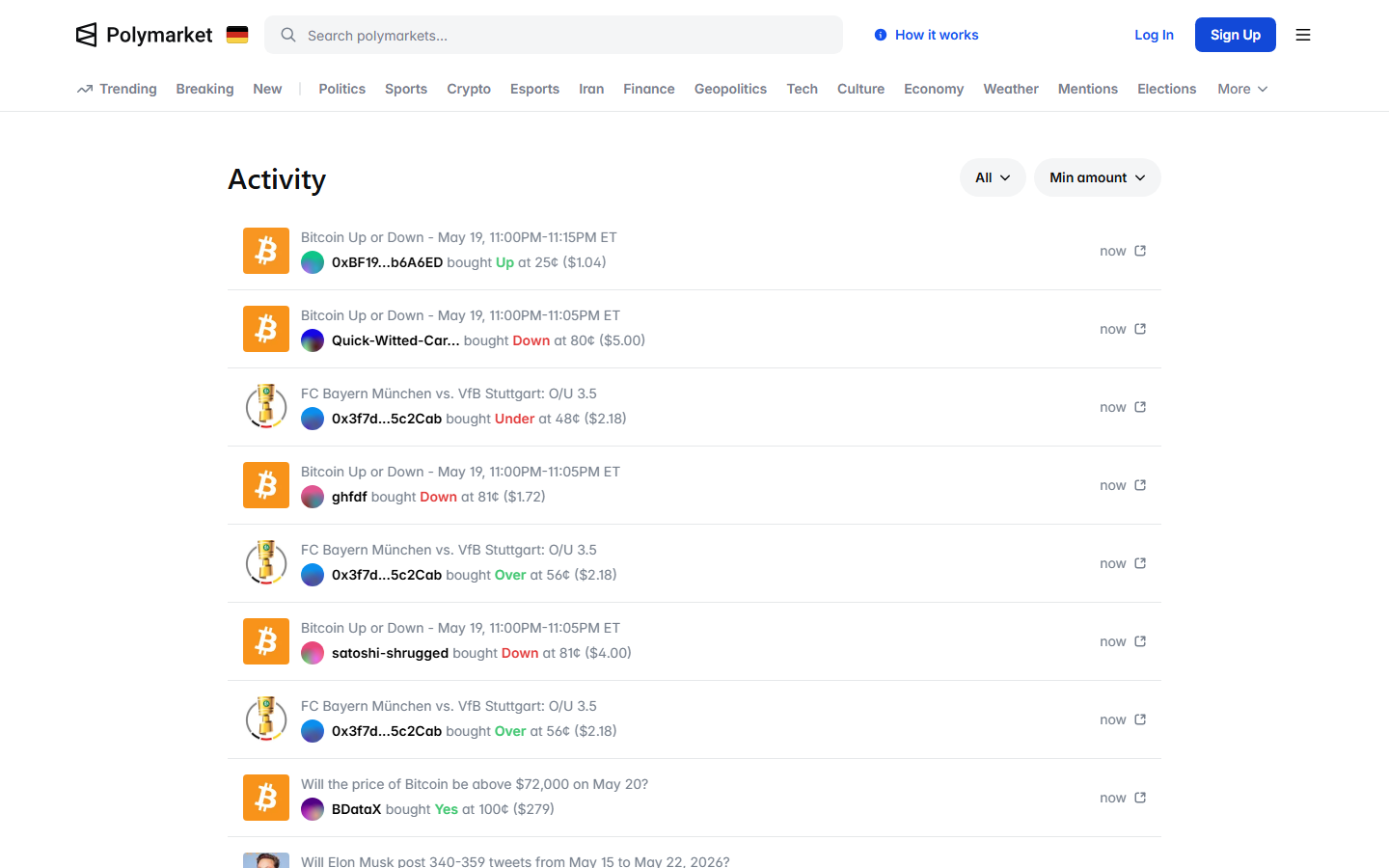
The Activity page helps you inspect recent public trades before opening a wallet. Look for large buys or sells, repeated orders in the same market, price moves that follow a trade, and whether the wallet keeps adding or starts trimming. A strong workflow is simple: watch /activity for fresh large trades, open /leaderboard to compare the wallet's broader rank, then use /checker for wallet-level PnL, ROI, positions, and history.
- Large buy after news: check whether the price already moved too far.
- Repeated sells into strength: check whether the wallet is exiting, not entering.
- Several strong wallets in one market: compare their entries and current exposure.
Start with /leaderboard to identify large and profitable wallets. Open /checker for the wallet's PnL, ROI, win rate, positions, and trade history. Use /activity to see whether the wallet is still active in the market.
Then read the Polymarket market page: title, rules, liquidity, spread, and resolution source. Whale tracking is useful only when you combine wallet context with market context.
A whale threshold depends on market liquidity. A five-figure position can matter in a niche market and barely register in a major election market.
Judge size relative to market depth, recent volume, and the wallet's own history. The same dollar amount can send different signals across markets.
Track whether the whale is building, trimming, or exiting. A large buy may look bullish, but repeated sells into strength can mean the wallet is reducing risk.
The activity page helps you see timing. The wallet checker helps you see whether the move fits the wallet's broader pattern.
A whale can move price in a thin market, attracting copy traders who enter at worse prices. If liquidity fades after the move, those copy traders can struggle to exit. Before reacting, compare your available price with the whale's likely entry and check whether enough bids or asks remain.
A stronger whale signal has size, timing, category history, repeat behavior, and a clear market rule. A weaker signal has size alone. Use the leaderboard for wallet context, the activity feed for timing, and the market page for rules and liquidity.
One whale can be noisy. Several large wallets entering the same market near the same time deserves closer attention, especially if the market has enough liquidity to absorb size.
Clusters still need context. Check whether wallets share a category history or whether they are reacting to the same public headline.
After a large buy, the next available ask can be much worse than the whale's entry. A whale signal loses value when your execution price already prices in the move.
Use the order book and recent activity before following. The signal is only useful if the remaining price still fits your thesis.
Check these official Polymarket sources before you act on referral terms, deposit methods, fees, availability, verification, or resolution details.
Last verified: May 20, 2026
Find large and active Polymarket wallets.
Review recent large trades before opening a wallet.
Tools and related reading referenced by this guide.
Continue with nearby Polymarket research topics.
Find Polymarket top traders, compare wallets by PnL, volume, ROI, and win rate, and understand the risks of copying smart money.
Use the Predicts.guru Polymarket wallet checker to look up trader PnL, open positions, win rate, trading history, and risk patterns.
Track Polymarket profit, loss, ROI, open positions, trading history, and wallet performance with Predicts.guru wallet analytics.